




Ugo Basile | Classic Hot and Cold Stimulation Experiment: An Introduction to the Rodent Hot Plate Test
Background and Purpose
The hot plate method, the "gold standard" for assessing thermal pain in rodents, has been widely acclaimed since its introduction in the mid-20th century. However, due to the highly subjective nature of pain, large-scale pain studies face limitations in standardizing evaluation criteria. Furthermore, conducting experiments directly on humans raises numerous ethical issues. Therefore, rodents, as the most common laboratory animals, are widely used in pain research due to their high genetic homology with humans, ease of breeding and reproduction, short modeling cycles, and strong stability.
The hot plate method is minimally damaging to animal tissues, easy to perform, and reproducible. Its long latency to pain response allows for subtle differences between experimental conditions. The latency (in seconds) for animals to initiate behaviors such as paw lifting, licking, and jumping in response to heat stimulation serves as a primary indicator of thermal pain sensitivity, enabling the distinction between hyperalgesia and allodynia.
Application Areas
Hot and cold plate testers are widely used to study the basic mechanisms of nociceptors, temperature sensing receptors, cold and heat allodynia and hypersensitivity, as well as for accurate and rapid screening of analgesics (such as opioids) in inflammatory and neuropathic pain, and to test the anti-nociceptive efficacy of compounds, such as the chronic constriction injury (CCI) model of the sciatic nerve.Experimental Preparation
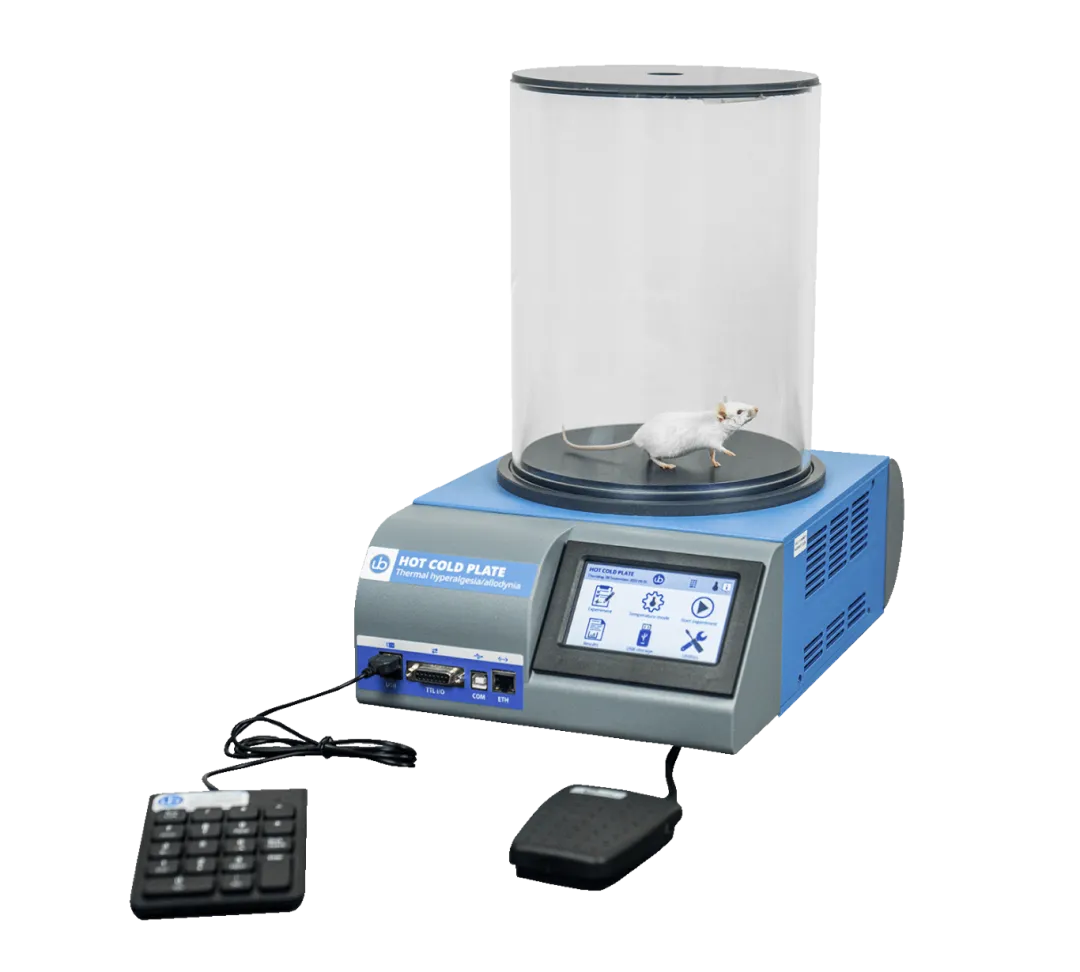
Equipment preparation:A hot and cold plate tester is required. This device provides stable temperature control and can record the animal's reaction time. The tester usually consists of a temperature-controlled metal plate and a transparent restrainer with a lid to limit the animal's range of movement.
Animal preparation:
To ensure experimental consistency, rats or mice of similar weight were selected;
Instrument disinfection:
Sterilize hot and cold plates with an ethanol solution;
Environmental adaptation:
Before the experiment begins, allow the animals to adapt to the experimental environment for 30-60 minutes to reduce stress response and improve experimental accuracy.
Experimental procedures
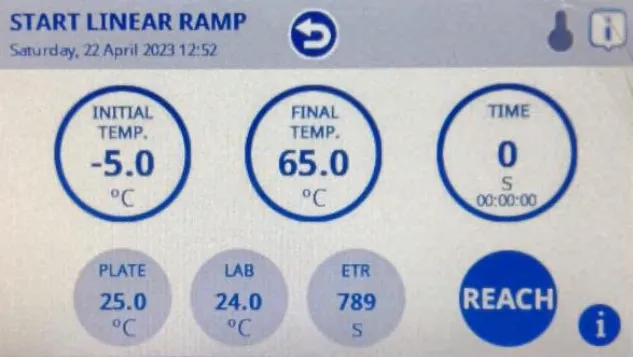
Device Setup(1) Using the Ugo hot and cold plate, you can choose the heating mode according to the experimental requirements: constant temperature mode, linear heating mode or rapid heating mode;
(2) In constant temperature mode, a constant temperature is set and the experiment duration can be set;
(3) In the linear heating mode, set the initial temperature, end temperature, total time or heating rate;
(4) In the rapid heating mode, set the initial and final temperatures and perform nonlinear rapid heating.

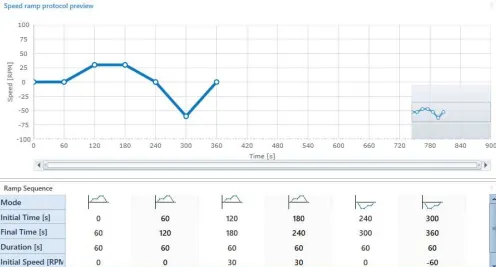
If using an Ugo hot and cold plate, you can also use the X-Pad app to customize the temperature ladder and import it into the device. You can also use the UB Lan device interconnection function to download experimental methods and output results to a computer.
Preheating/precooling equipment
Start the hot and cold plates and allow them to heat or cool to the set initial temperature.
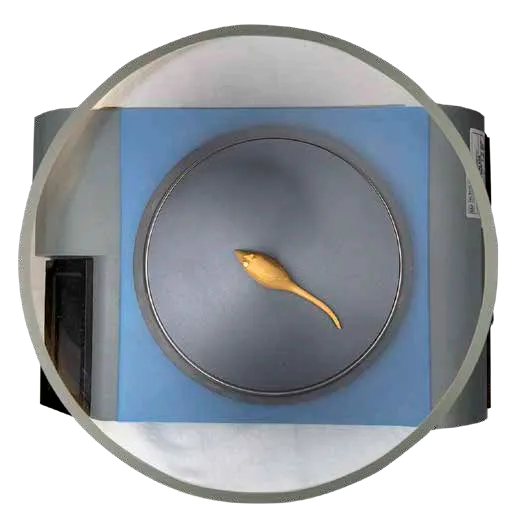
Animal placement
Place the animals on the hot and cold plates, ensuring they have space to move freely without being restrained.
Behavioral observation and recording
Closely observe the animal's behavioral responses and use a numeric keypad or other recording method to record the time of the first abnormal reaction, such as lifting a foot, licking, scratching, jumping, etc. If the animal does not show any abnormal reaction within 20 seconds, immediately remove the animal from the hot and cold plates and end the experiment.
If you use the Ugo Basile hot and cold plates, you can use the numeric keypad to record the different behaviors of animals. Different numeric keys correspond to different behaviors, which can be customized by the user for easy recording.
Data collection and analysis
Data such as the time and latency of abnormal reactions were collected from all animals, and statistical analysis was performed to evaluate the differences in animals' pain perception and reactions.
End of experiment
After the experiment is completed, clean and maintain the hot and cold plates to ensure that the equipment is in good condition and ready for the next use.
Literature Case
To investigate whether NCX3 (sodium-calcium exchanger type 3) regulates pain behavior, we performed a hot plate test in wild-type (WT) and NCX3 heterozygous (NCX3HET) and NCX3 homozygous (NCX3HOM) mutant mouse lines lacking functional NCX3.Each mouse was placed on a hot plate maintained at a constant temperature (50°C or 55°C);
The time it took for each mouse to produce a nociceptive response (hind paw withdrawal or licking) was recorded, and the average value was used for comparison;
Combined with other behavioral experiments, it was confirmed that the loss of NCX3 is associated with normal acute pain-related behaviors.
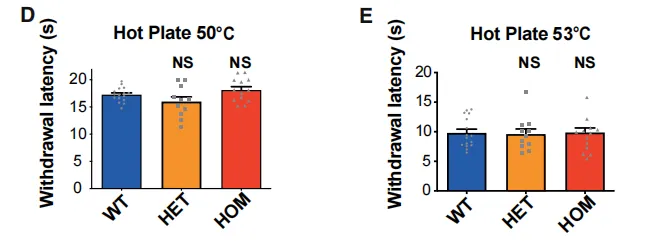
Source: Trendafilova, Teodora, et al. "Sodium-calcium exchanger-3 regulates pain “wind-up”: From human psychophysics to spinal mechanisms." Neuron 110.16 (2022): 2571-2587. doi: null IF 18.69
Experimental Notes
Animal selection and acclimation:Select healthy mice or rats and ensure they are acclimatized to the experimental environment before the experiment to reduce the impact of environmental factors on the experimental results;
Equipment inspection:
Ensure that the hot and cold plate equipment is working properly and set the appropriate temperature and maximum reaction time. Usually the hot plate temperature is set at 52-55℃, and the cold plate temperature is set according to the experimental requirements;
Temperature Control:
During the experiment, the environment should be kept quiet and stable to avoid external factors interfering with the animal's response. The laboratory temperature should be kept consistent every time to ensure the accuracy and stability of temperature control.
Observe and record:
After the animals are placed on the hot and cold plates, their reaction time to temperature stimulation, such as jumping, licking feet, etc., is recorded. Be careful to remove the animals immediately after they show pain behavior to avoid tissue damage;
Experimental reproducibility:
Each animal can undergo multiple experiments, but a certain interval (e.g., 15 minutes) is required to avoid the cumulative effect of pain sensitivity, and a control group should be set up to exclude the influence of other factors on the experimental results;
Data processing:
The reaction times of each group of animals were averaged, and appropriate statistical methods were used to compare differences in pain thresholds between groups;
Cleaning and disinfection:
After the experiment, the instrument should be cleaned and disinfected to avoid contamination and to remove any dirt or debris that may remain on the platform.
Equipment Introduction
The Ugo Basile hot and cold plate is designed specifically for testing hot and cold pain sensation in rodents. With a temperature adjustment range of -5°C to 65°C, it meets the needs of both cold and heat pain experiments. Its multi-stage temperature setting supports the ramping hot plate method, making it suitable for screening non-potent analgesic drugs. The instrument's standard numeric keypad allows the numbers 0-9 to be assigned to ten different animal responses (such as paw lifting, licking, scratching, jumping, and grooming). It simultaneously records a variety of experimental phenomena, linking pain perception with behavioral research. The hot and cold pain test accurately reflects phenomena such as hyperalgesia and allodynia, and is primarily used for pain mechanism research and analgesic drug screening.
Partial user list
