




A guide to the 50% withdrawal threshold for mice and rats: Accurate assessment of pain quantification
Historical background
In the 1890s, physiologist Maximilian von Frey proposed that pain is an independent tactile property, on par with touch, heat, and cold, and is related to the stimulation of high-threshold free nerve endings. Measuring mechanical pain (pinprick pain) is currently a common method for assessing mechanical pain in experimental mice.In 1983, Dixon proposed the up–down method using Von Frey fibers. In 1994, Chaplan et al. further modified this method to determine the 50% paw withdrawal threshold in rodents. The up–down method is individually calibrated within 5% standard deviation of the target force level, making it highly accurate. Currently, the up–down method has been cited in tens of thousands of publications, making it the gold standard for measuring mechanical pain thresholds. Approximately 60% of published studies measuring paw withdrawal thresholds use the up–down method or a modified version thereof.
Preparation before the experiment
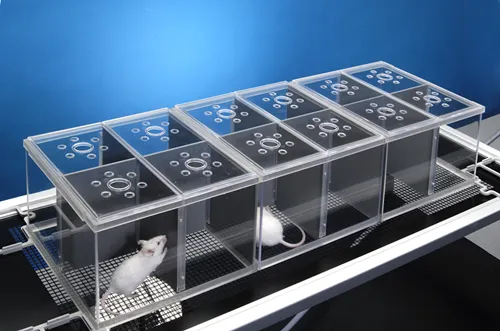
Adapting to the environmentPlace the rodents in a special organic glass compartment with a grid at the bottom and acclimate for about 20 minutes until the animals are well adapted to the current environment and their limbs do not move frequently.
Preliminary experiment
Before the experiment begins, perform a preliminary test on the animals using Von Frey fibers to measure the approximate range of their withdrawal thresholds. This helps screen the animals and fibers. Whenever possible, select animals with similar withdrawal thresholds and fibers with consecutive numbers to ensure accurate data.
Get started
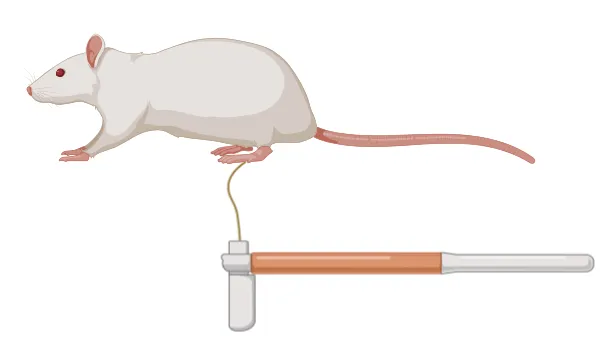
Steps1. Take a series of North Coast Von Frey fibers (e.g., 0.4, 1.0, 1.4, 2.0, 4.0, 6.0, 8.0, 10.0, and 15.0 g, for a total of 9). Use the median weight of 4.0 g. Initially stimulate the skin in the middle of the animal's paw. Bend the fiber into a "C" or "S" shape and maintain it for 6-8 seconds. Observe and record whether the animal withdraws its paw. Test each fiber five times, with 15-second intervals between each test. A withdrawal response is considered present if the paw withdraws three out of five times. Be careful to distinguish withdrawal responses caused by physical activity.
2. If the animal shows no reaction, record it as "O"; if it shows a reaction (withdrawal or licking), record it as "X". If the animal shows no reaction, stimulate it with a higher-strength fiber (i.e., if the animal shows no reaction to a 4.0g fiber, stimulate it with a 6.0g fiber). If the animal shows a reaction, stimulate it with a lower-strength fiber (i.e., if the animal shows withdrawal to a 4.0g fiber, stimulate it with a 2.0g fiber). Repeat this process.
3. When the animal mounts an "OX" (no withdrawal reaction the first time, withdrawal reaction the second time) or an "XO" (withdrawal reaction the first time, no withdrawal reaction the second time), repeat the previous steps and measure four more times in a row to obtain a sequence of "O" or "X" combinations ①. Enter this sequence and the number of the last test wire into the animal's 50% withdrawal threshold formula to calculate the animal's 50% withdrawal threshold.
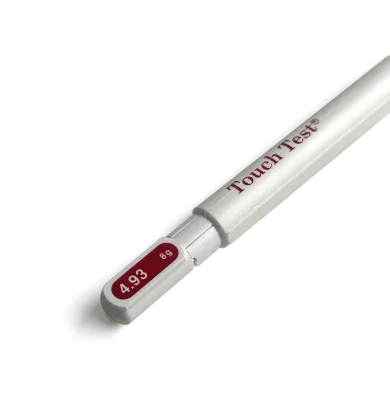
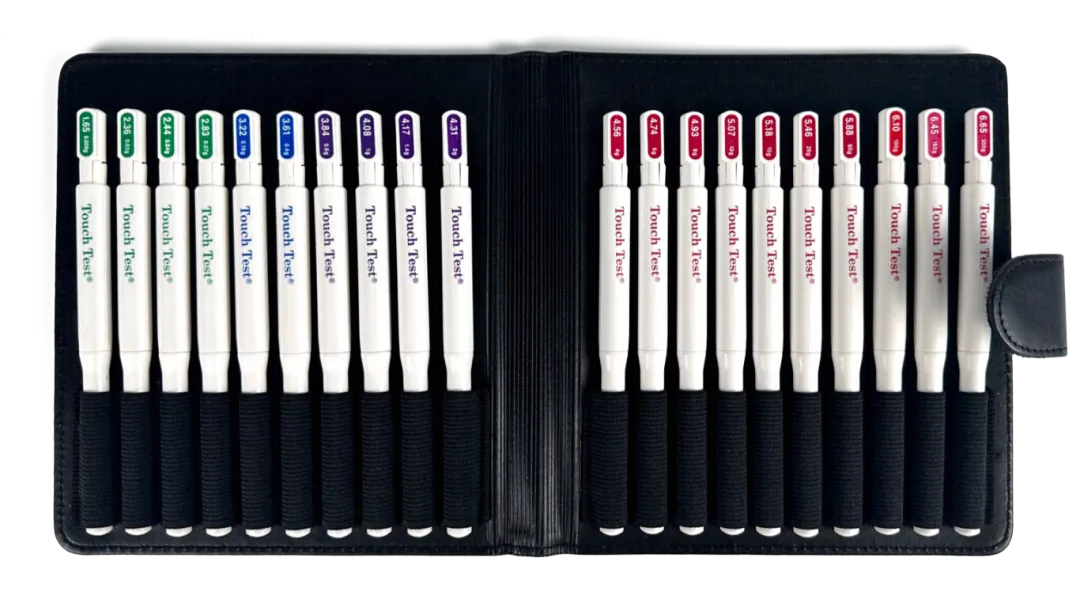
4. 50% paw withdrawal threshold (g) = (10^[Xf + kδ])/10000, where Xf ② is the number of the last tested thread. As shown in the figure below, the 8.0 g North Coast thread is numbered 4.93. δ is the mean difference in the logarithms of the weights of the individual threads. This value is very close to the North Coast thread number. For ease of calculation, δ can be approximated as the mean difference in the selected thread numbers: δ = (maximum thread number - minimum thread number) / (n-1), where n is the number of threads selected. k is the coefficient obtained by looking up the table based on the measured "X" and "O" sequences.
Precautions
1. The "O" or "X" sequence mentioned here refers to the sequence starting from the first test, and continuing four times after the occurrence of the mount value, with a minimum of six digits and a maximum of nine digits. Sequences with less than six digits are not considered. If an animal mounts between 4.0 and 6.0 at the beginning and repeatedly mounts in subsequent tests, the sequence is "OXOXOX"; if an animal does not mount at the beginning, but then mounts between 8.0 and 10.0 and repeatedly, the sequence is "OOOXOXOX";
2. Xf is calculated directly using the test filament number. However, some literature uses the logarithm of 10 times the target strength value (in mg) of the last filament as Xf, i.e., Xf = lg(10000f), where f is the target strength of the filament (g). The Xf value calculated using this method is very close to the filament number itself, so the filament number can be used directly as Xf in the calculation.
Calculation Example
There are 9 fibers at 0.4, 1.0, 1.4, 2.0, 4.0, 6.0, 8.0, 10.0, and 15.0g. We choose the middle 4.0g force to start the test.
1. First Round:
Select a 4.0g fiber to stimulate five times, with a 15s interval between each stimulation, and no paw withdrawal occurs three or more times in the five stimulations (O)
Select a 6.0g fiber to stimulate five times, with a 15s interval between each stimulation. No paw withdrawal occurs three or more times in the five stimulations (O).
Select 8.0g fiber to stimulate five times, with an interval of 15 seconds between each stimulation, and paw withdrawal occurs three or more times in the five stimulations (X)
At this point, the first straddle occurred, and the previous test was repeated to continue testing the four wheels.
2. Second Round:
Select a 6.0g fiber to stimulate five times, with an interval of 15 seconds between each stimulation. No paw withdrawal occurs three or more times in the five stimulations (O).
3. Round 3:
Select 8.0g fiber to stimulate five times, with an interval of 15 seconds between each stimulation, and paw withdrawal occurs three or more times in the five stimulations (X)
4. Round 4:
Select 6.0g fiber stimulation five times, each time with an interval of 15 seconds, and no paw withdrawal reaction occurs three or more times in the five times (O) Round 5: Select 8.0g fiber stimulation five times, each time with an interval of 15 seconds, and no paw withdrawal reaction occurs three or more times in the five times (O)

The sequence is OOXOXOO. According to the k value table, k = 0.039;
The second step is to calculate the mean difference according to the number:
The mean difference of the numbers corresponding to these 9 fibers (3.61, 4.08, 4.17, 4.31, 4.56, 4.74, 4.93, 5.07, 5.18) is δ = (5.18-3.61)/(9-1) = 0.19625;
The third step is to determine Xf:
The last fiber is 8.0g, and the corresponding number can be found on the North Coast fiber as 4.93;
The fourth step is to substitute the formula into the calculation:
Substituting this into the formula, we can get g = 10[4.93+0.039*0.19625]/10000 = 10 0.93765. Using a scientific calculator, we can get the 50% foot withdrawal threshold of an animal (g) = 8.66g, which is the 50% foot withdrawal threshold of an animal.
Experimental Notes
If the animal shows a response four times in a row starting from 4.0 g (i.e., the animal still shows a paw withdrawal or paw licking response at 0.4 g) or does not show a response four times in a row (i.e., the animal still does not show a paw withdrawal or paw licking response at 15.0 g), 0.4 g or 15.0 g can be directly used as the animal's 50% paw withdrawal threshold;
If a riding reaction occurs at the beginning, but the minimum or maximum fiber is tested less than 4 times (such as XXXOXX), continue to use the minimum or maximum fiber to measure and record according to the Up-Down method to eliminate the possibility of false positives or false negatives.
North Coast Fiber Filament Kit
Product IntroductionThe North Coast Von Frey Fiber Pain Threshold Test Kit is a classic tool for assessing skin tactile sensitivity. It consists of 20 Von Frey fibers of varying sizes, each consisting of a fiber head, a protective sleeve, and a handle. The force of the fibers can be measured from 0.008g to 300g. Von Frey fiber tactile testing can be applied to the soles of rats and mice and is widely used clinically for tactile testing and diagnosis of hyperawareness and hypoawareness.
Application Areas
Basic research and applied research on the coding mechanism of mechanoreceptor: By measuring the sensitivity threshold corresponding to different fiber diameters, the characteristics of different types of receptors can be inferred;
Evaluate nerve reconstruction after injury: Observe the recovery of the stimulation threshold of the fiber filaments to monitor the process of nerve regeneration and functional repair;
Studying pain regulation mechanisms: Using animal models to study the effects of drugs or interventions on mechanical pain thresholds helps to understand pain regulation pathways.
Clinical diagnostic applications: Assessing the degree of peripheral nerve damage: By measuring the patient's perception threshold to fiber stimulation, the degree of sensory nerve function damage can be determined. This helps diagnose and monitor peripheral neuropathy;
Diagnosis of diabetic neuropathy: Diabetic patients often experience mechanical paresthesia. The use of fiber filaments can objectively assess sensory nerve function and help diagnose diabetic peripheral neuropathy.
Assessment of central pain: For central pain such as pain after spinal cord injury, fiber filaments can be used to assess changes in mechanical sensory thresholds to aid diagnosis.
Partial user list