


Experimental Tips | Uncovering the Secrets of Memory: A Complete Analysis of the Morris Water Maze Experiment
Date:2025-06-17
Author:
Experimental background and purpose
The Morris water maze, first designed and applied by British psychologist Morris in the 1980s, is an experimental method for assessing learning and memory. By forcing experimental animals to swim in a water tank, search for, and memorize the location of a hidden platform, it assesses their ability to learn and remember spatial position and direction. This method has been widely used in research on the mechanisms of learning and memory, as well as in drug discovery. It is also commonly used in research related to learning and memory, such as intelligence, aging, and Alzheimer's disease (AD).Experimental principle: How animals learn and remember
Water is a natural enemy for mice and rats. When placed in a pool, they eagerly seek an escape route. Their typical behavior is to search for an exit around the pool walls, but the deep, smooth vertical walls hinder this attempt. The submerged platform becomes their only "safe zone," forcing the animals to rely on environmental cues for orientation—a crucial test of spatial reference memory! After repeated training, they develop a stable "mental map," a process highly similar to human memory formation.The classic Morris water maze experiment, through repeated training, allows mice to learn to find a hidden platform in a fixed position, ultimately developing stable spatial cognition. This spatial cognition relies on processing spatial information (external environmental cues).
Experimental process breakdown: How to do the water maze experiment
Learning phase: Establishing basic cognition This phase is used to relieve the stress of mice on unfamiliar tasks and increase their understanding of task rules.Pool settings: Water temperature around 21°C, water level 1-2cm lower than the platform; if the platform is non-transparent, sprinkle dye in the water to hide the platform
Operation process:
Entering the water: Randomly select a starting point and gently place the mouse into the water facing the pool wall (avoiding extra pressure caused by the head downwards);
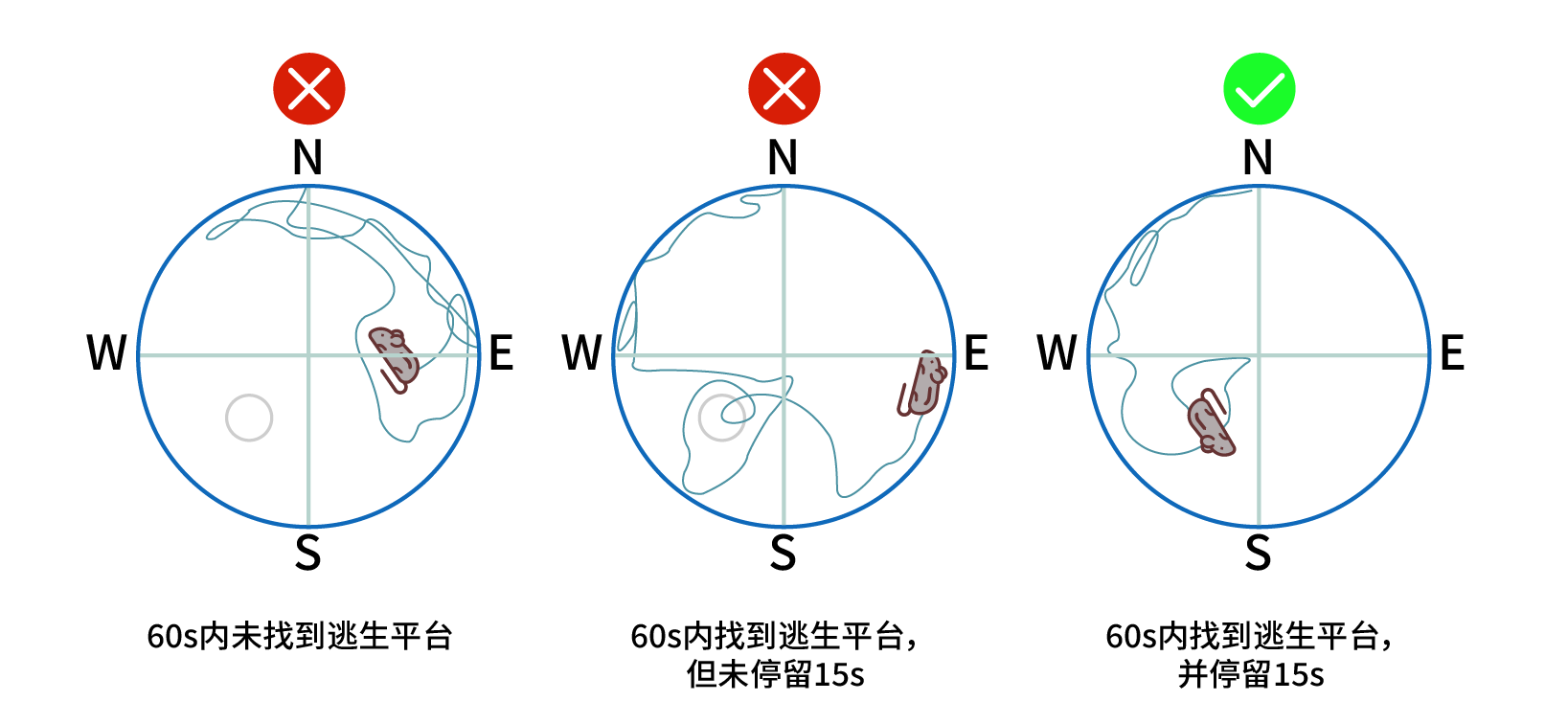
Timing and observation: If the mouse finds the escape platform and stays on it within 60-90 seconds, let it stay there for 15-30 seconds and then remove it from the pool. If the mouse fails to reach the platform within 60-90 seconds, or jumps into the water after finding the platform, guide it to the escape platform and let it stay there for 15-30 seconds.
Water removal: After the mouse has finished its stay on the platform, gently dry it with a towel; if necessary, use a warming pad to maintain its body temperature, and then return it to the cage to rest;
Repeat the experiment: The experiment was conducted for 4 consecutive days, 4 times a day, and each quadrant could only be used once a day.
Spatial learning stage: Challenge upgrade This stage is used to test the mice's ability to learn space
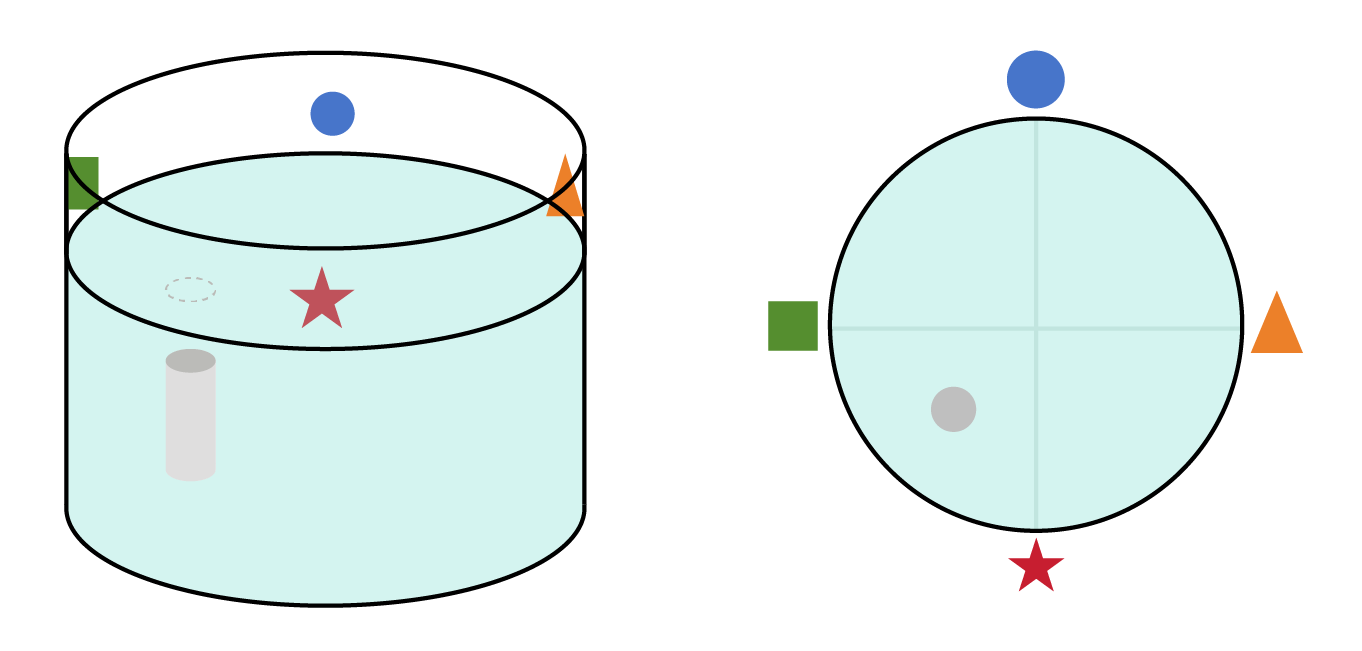
Pool setup: Randomly change the position of the platform, the water level should be 1~2cm higher than the platform. If the platform is non-transparent, sprinkle dye in the water to hide the platform. Keep the water temperature around 21℃.
Operation process:
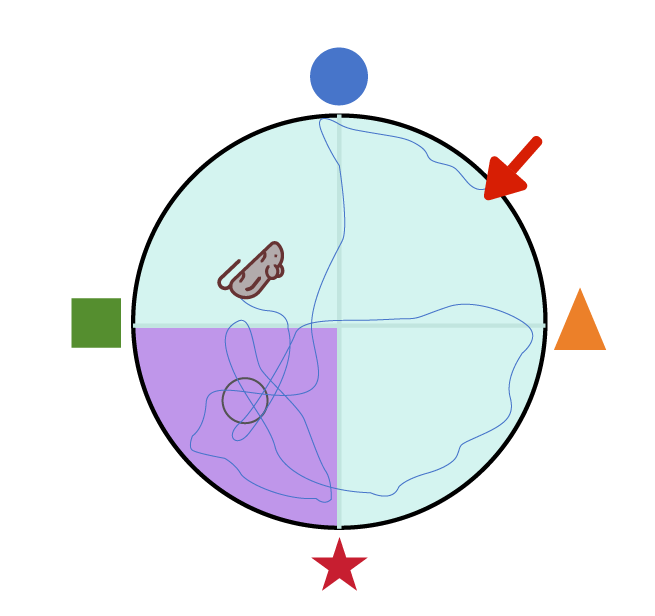
Entering the water: Place the rat in the water facing the pool wall from any of the four quadrants (northeast, northwest, southeast, southwest), with the cycle order randomized and the platform placed in the southeast quadrant;
Timing and observation: If the mouse finds the escape platform and stays on it within 60-90 seconds, let it stay there for 15-30 seconds and then remove it from the pool. If the mouse fails to reach the platform within 60-90 seconds, or jumps into the water after finding the platform, guide it to the escape platform and let it stay there for 15-30 seconds.
Sometimes, mice may fall off the platform or jump into the water to continue swimming before the scheduled 10-30 second platform stay time is over. If this happens, the experimenter should immediately place the mouse back on the platform and restart the timer to ensure that it completes the full 10-30 second stay. This operation ensures that each mouse can obtain an equal amount of platform stay time after each experiment to observe the environment and obtain necessary spatial information;
Water treatment: After completing the platform stay, gently dry the mouse with a towel. If necessary, use a heating pad to maintain its body temperature, and then return it to the cage to rest.
Spatial memory stage: Verify long-term memory at a fixed time point 24 hours after the end of the spatial learning experimental training
Pool setup: Remove the platform, and keep all other settings (water temperature, light control, etc.) the same as the learning phase
Operation process:
Entering the water: Gently place the animal into the water from any entry point of the tank facing the pool wall;
Observation and recording: Observe and record the animal's movement trajectory within 60-90 seconds;
Detection indicators include:
- The time spent in the quadrant where the original escape platform is located
-The percentage of movement distance in the quadrant where the original escape platform is located to the total movement distance
-Average swimming speed
-The number of times the original escape platform position was crossed;
Water treatment: After completing the platform stay, gently dry the mouse with a towel. If necessary, use a heating pad to maintain its body temperature, and then return it to the cage to rest.
Pitfall Avoidance Guide: These details may ruin your experiment!
Time management: Test at a fixed time each day to avoid interference with the animal's biological clock.Water level control: mark the initial water level line and add water in time during the experiment.
Animal adaptation: Elderly animals can enter the water multiple times or swim for extended periods of time.
Controlled variables: Animal sex, strain, pool size, water temperature… small differences can skew your results!
Water quality management: Avoid changing water between animals to reduce stress caused by environmental changes.
Visual distraction: Draw the blackout curtain to ensure that the animal relies only on spatial cues.
Water maze experimental equipment: double your efficiency!
To do one's work well, one must first sharpen his tools! Yuyan Instruments provides a one-stop water maze solution: Yuyan Instruments' Morris Water Maze Experiment System provides a complete set of equipment for the Morris Water Maze experiment, including a constant-temperature swimming pool, video acquisition equipment, and video analysis equipment. This system can efficiently and objectively and reliably evaluate the learning and memory levels of experimental animals, providing accurate and effective experimental data for basic research on AD, preclinical diagnosis and treatment, and other learning and memory-related research.Intelligent hardware: The water tank is durable, non-toxic and odorless, and has a constant temperature system to ensure the validity of experimental data and animal safety;
Precise temperature-controlled water bath: The water temperature is adjustable and maintained stably, with precise control accuracy, effectively ensuring the normal physiological state of experimental animals;
High-definition behavior recording: equipped with high-pixel lenses, the video quality is clear, making it easy to observe animal behavior and accurately capture the critical moments of behavior;
Supports starlight mode to reduce ambient light interference: It can shoot and perform video analysis in low-light conditions, which is more in line with the living habits of rodents (such as rats and mice) and reduces environmental interference;
Rich measurement parameters and functions: Video analysis software can measure and analyze important parameters obtained from experiments.