




Technical Analysis | Brain Function Ultrasound Imaging System: A New Key to Unlocking the Mysteries of Brain Science!
Date:2025-07-29
Author:Yuyan Instrument
As the core organ of neural control, the brain plays a crucial role in behavioral activities, sensory feedback, and psychological activities. Researchers have always focused on the function and structure of the brain, using traditional research tools such as magnetic resonance imaging (MRI) and electroencephalography (EEG).
However, MRI imaging suffers from low spatial and temporal resolution, high equipment costs, and limited testing conditions, making it difficult to accurately image brain activity in real time. EEG testing in rats and mice is typically invasive and lacks intuitive spatial assessment. With advances in material technology and hardware, functional brain imaging is emerging as a new brain science research tool to address these shortcomings.
The main functional brain imaging technologies (categorized as localized and whole-brain imaging) are displayed on a 3D chart (temporal resolution, spatial resolution, and portability). Functional brain imaging bridges the gap between whole-brain imaging and microscopic observation, as well as between functional magnetic resonance imaging and optical techniques.
As a new generation of brain science research tools, functional brain ultrasound offers imaging resolutions of hundreds of microns and rapid temporal resolution, enabling the detection and long-term monitoring of neural activity throughout the brain. Its ease of use, portability, and spatial and temporal resolution make it an attractive tool for functional imaging of brain activity in preclinical imaging.
A large and rapidly growing body of research has demonstrated its potential in neuroscience research, using a variety of animal models, from small to large. Common applications include studying brain diseases such as stroke and epilepsy, functional connectivity studies of brain regions, neurofeedback studies of fast transient events, high-sensitivity spatial functional mapping, and multimodal imaging.
In 2024, Seongyeon et al. conducted a study on the combined application of focused ultrasound and functional brain ultrasound imaging (fUS) in cerebral blood flow regulation in mice, targeting the two core issues of "in situ targeting confirmation" and "functional effect monitoring" in focused ultrasound (FUS) neuromodulation.
This study established a complete "targeting-modulation-monitoring" closed-loop by integrating displacement imaging (used to confirm FUS target location), FUS (responsible for regulating neuronal activity), and functional ultrasound (fUS, used to monitor hemodynamic changes). Using fUS, the research team successfully captured the hemodynamic changes in the FUS-regulated area, achieving the first fully ultrasound-mediated closed-loop study of FUS neuromodulation. This approach fills the gaps in traditional methods for in situ target confirmation and real-time functional monitoring, providing a visualization tool with high temporal and spatial resolution for FUS neuromodulation.
The study further confirmed that FUS-induced brain tissue displacement is a key mechanical factor driving hemodynamic response, and this effect is dose-dependent with FUS parameters, providing in vivo evidence for the "acoustic radiation force-displacement-neurovascular coupling" mechanism of action, helping to clarify the biophysical basis of FUS neuromodulation.
This achievement not only provides a precise regulation solution for non-invasive intervention research on models of neurodegenerative diseases and stroke, but also lays an important foundation for parameter optimization and safety evaluation of FUS in clinical neuroregulation.
Schematic diagram of focused ultrasound (FUS) and functional ultrasound (fUS) applications
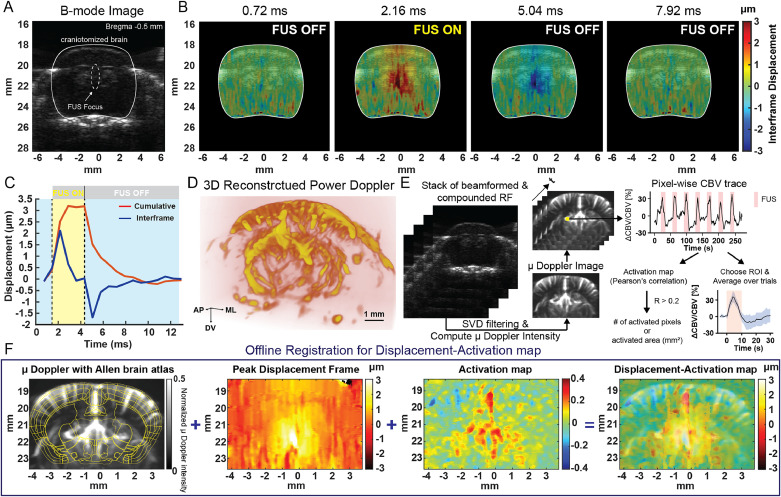
Functional responses to central FUS stimulation. FUS showed that FUS induced hemodynamic responses in cortical and subcortical structures.
Verification of spatiotemporal matching between brain functional imaging and neuronal activity
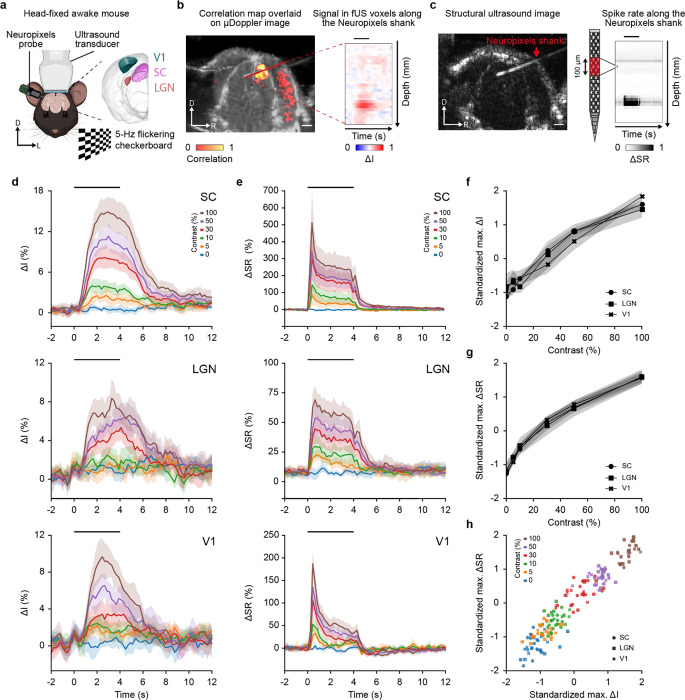
In 2024, Théo Lambert et al. investigated the accuracy of spatiotemporal alignment between functional ultrasound (fUS) and neuronal activity. By performing simultaneous fUS imaging and recording neuronal firing using Neuropixels high-density electrodes in three regions of the mouse visual pathway (the thalamus LGN, midbrain SC, or cortical V1), they revealed spatiotemporal correlations between fUS signals and neuronal spike rates, providing a basis for accurate interpretation of fUS signals.
Studies have confirmed that fUS signals can serve as a reliable estimate of local neuronal activity, and changes in their amplitude, spatial range, and temporal characteristics are proportional to the spike rate. These findings provide key evidence for the application of fUS in whole-brain functional network research, neural prosthesis control, and other fields, and also lay the foundation for more accurate interpretation of fUS signals.
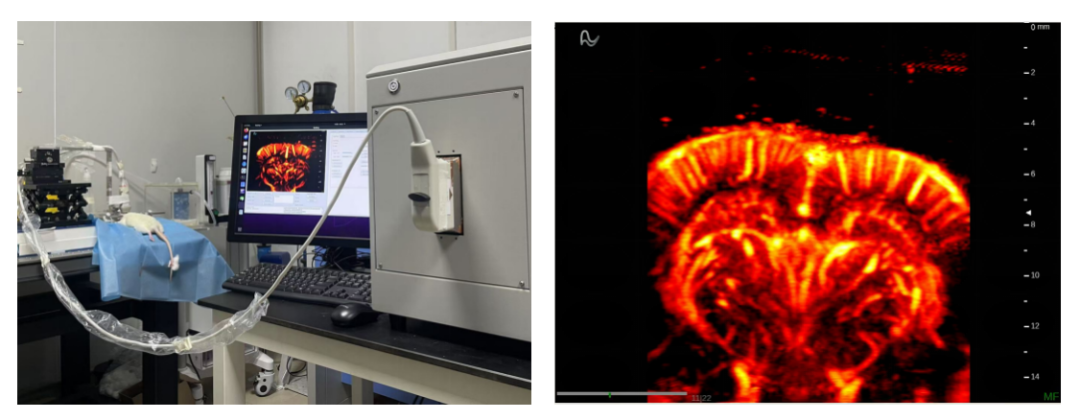
SonoRover fUS is a high-resolution brain function ultrasound imaging system designed specifically for experimental animals. Equipped with a high-performance processor and advanced microvascular blood flow imaging algorithms, it can image the whole brain function of experimental animals such as mice and rats with high temporal and spatial resolution. Equipped with a variety of high-frequency transducers, it can accurately match experimental animals of different depths and sizes, and features a unique integrated diagnostic and therapeutic probe that enables simultaneous neural regulation and imaging. This technology has enormous potential for application in neuroscience, such as research on brain function disorders, neural feedback regulation, drug screening for brain diseases, neuropsychiatric disease research, and brain-computer interfaces.
Verification of spatiotemporal matching between brain functional imaging and neuronal activity
Whole-brain deep brain imaging: Capable of simultaneously capturing detailed information about the entire brain and deep brain regions, expanding the imaging coverage;
High frame rate brain imaging: supports fast dynamic imaging, capturing rapid changes in brain functional activities, suitable for real-time monitoring;
High spatial resolution: With fine spatial resolution, it ensures that tiny brain structures are clearly presented to improve diagnostic accuracy;
High temporal resolution: With extremely high temporal resolution, it can accurately capture instantaneous fluctuations in brain functional activities and support dynamic analysis
Ultrasound diagnosis and treatment integrated module
Integrated diagnosis and treatment: Integrates ultrasound imaging and neuromodulation functions, supporting synchronous or independent working modes;
High-performance hardware: equipped with a 128-element probe and a 5-10MHz wide frequency range, balancing imaging resolution and depth control;
Modular expansion: flexibly adapt to multiple scenarios and provide more innovative applications for scientific research and clinical practice
Application Scenario
Neurological disease model research: used for functional evaluation of small animal neurological disease models to help explore the pathogenesis of diseases such as brain injury, stroke, epilepsy, and Parkinson's disease;
Brain Functional Network and Behavior Research: Analyze brain functional activity in small animals while they perform specific behavioral tasks, and explore the role of neural networks in cognitive, emotional, and motor behaviors;
Drug screening and efficacy evaluation: used to evaluate the effects of drugs or treatments on brain function and provide real-time monitoring of changes in brain function;
Gene editing and neural regulation research: combining gene editing technology to study the effects of specific genes on brain function in small animals;
Brain-computer interface technology research: Explore the application of brain-computer interface technology in small animal experiments, study the interaction between brain signals and external devices, and lay the foundation for the future clinical application of brain-computer interface
However, MRI imaging suffers from low spatial and temporal resolution, high equipment costs, and limited testing conditions, making it difficult to accurately image brain activity in real time. EEG testing in rats and mice is typically invasive and lacks intuitive spatial assessment. With advances in material technology and hardware, functional brain imaging is emerging as a new brain science research tool to address these shortcomings.
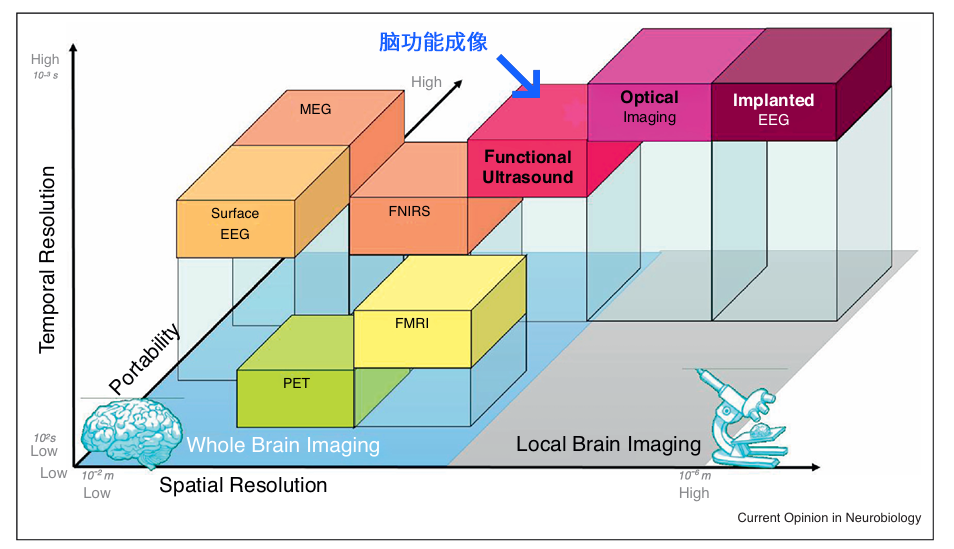
The main functional brain imaging technologies (categorized as localized and whole-brain imaging) are displayed on a 3D chart (temporal resolution, spatial resolution, and portability). Functional brain imaging bridges the gap between whole-brain imaging and microscopic observation, as well as between functional magnetic resonance imaging and optical techniques.
As a new generation of brain science research tools, functional brain ultrasound offers imaging resolutions of hundreds of microns and rapid temporal resolution, enabling the detection and long-term monitoring of neural activity throughout the brain. Its ease of use, portability, and spatial and temporal resolution make it an attractive tool for functional imaging of brain activity in preclinical imaging.
A large and rapidly growing body of research has demonstrated its potential in neuroscience research, using a variety of animal models, from small to large. Common applications include studying brain diseases such as stroke and epilepsy, functional connectivity studies of brain regions, neurofeedback studies of fast transient events, high-sensitivity spatial functional mapping, and multimodal imaging.
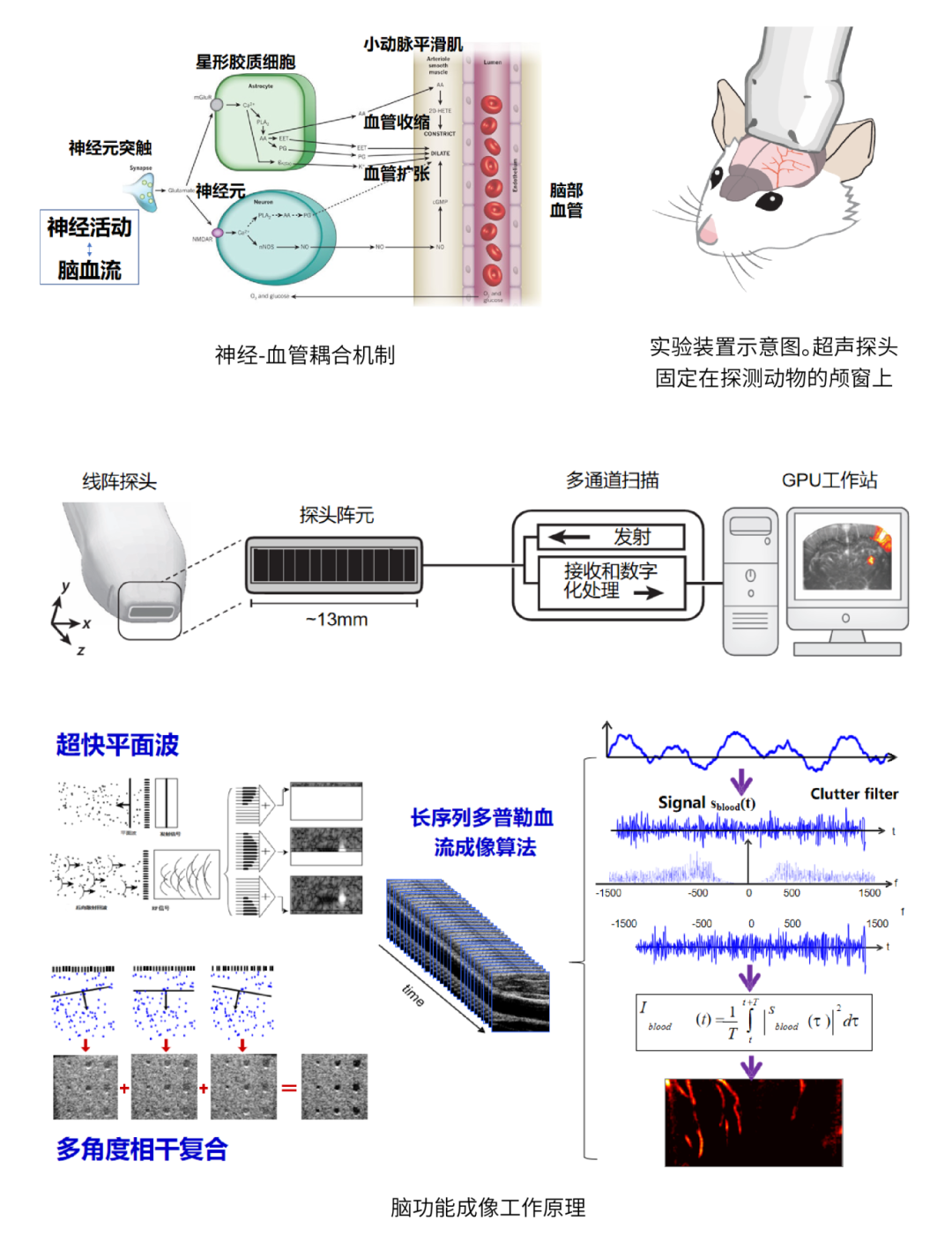
Principles of functional brain ultrasound imaging
fUS brain functional ultrasound imaging uses ultrafast ultrasound and ultrasensitive blood flow imaging technology to obtain tiny blood flow changes in brain tissue. Based on the neurovascular coupling mechanism, it can obtain the state of brain functional activity in real time.Application examples of functional brain ultrasound imaging
Feedback study of brain functional ultrasound on focused ultrasound neural targetingIn 2024, Seongyeon et al. conducted a study on the combined application of focused ultrasound and functional brain ultrasound imaging (fUS) in cerebral blood flow regulation in mice, targeting the two core issues of "in situ targeting confirmation" and "functional effect monitoring" in focused ultrasound (FUS) neuromodulation.
This study established a complete "targeting-modulation-monitoring" closed-loop by integrating displacement imaging (used to confirm FUS target location), FUS (responsible for regulating neuronal activity), and functional ultrasound (fUS, used to monitor hemodynamic changes). Using fUS, the research team successfully captured the hemodynamic changes in the FUS-regulated area, achieving the first fully ultrasound-mediated closed-loop study of FUS neuromodulation. This approach fills the gaps in traditional methods for in situ target confirmation and real-time functional monitoring, providing a visualization tool with high temporal and spatial resolution for FUS neuromodulation.
The study further confirmed that FUS-induced brain tissue displacement is a key mechanical factor driving hemodynamic response, and this effect is dose-dependent with FUS parameters, providing in vivo evidence for the "acoustic radiation force-displacement-neurovascular coupling" mechanism of action, helping to clarify the biophysical basis of FUS neuromodulation.
This achievement not only provides a precise regulation solution for non-invasive intervention research on models of neurodegenerative diseases and stroke, but also lays an important foundation for parameter optimization and safety evaluation of FUS in clinical neuroregulation.
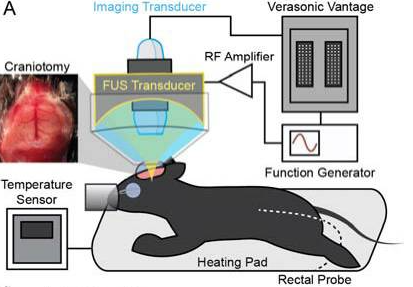
Schematic diagram of focused ultrasound (FUS) and functional ultrasound (fUS) applications
Functional responses to central FUS stimulation. FUS showed that FUS induced hemodynamic responses in cortical and subcortical structures.
Verification of spatiotemporal matching between brain functional imaging and neuronal activity
In 2024, Théo Lambert et al. investigated the accuracy of spatiotemporal alignment between functional ultrasound (fUS) and neuronal activity. By performing simultaneous fUS imaging and recording neuronal firing using Neuropixels high-density electrodes in three regions of the mouse visual pathway (the thalamus LGN, midbrain SC, or cortical V1), they revealed spatiotemporal correlations between fUS signals and neuronal spike rates, providing a basis for accurate interpretation of fUS signals.
Studies have confirmed that fUS signals can serve as a reliable estimate of local neuronal activity, and changes in their amplitude, spatial range, and temporal characteristics are proportional to the spike rate. These findings provide key evidence for the application of fUS in whole-brain functional network research, neural prosthesis control, and other fields, and also lay the foundation for more accurate interpretation of fUS signals.
Brain Function Ultrasound Imaging Product Introduction
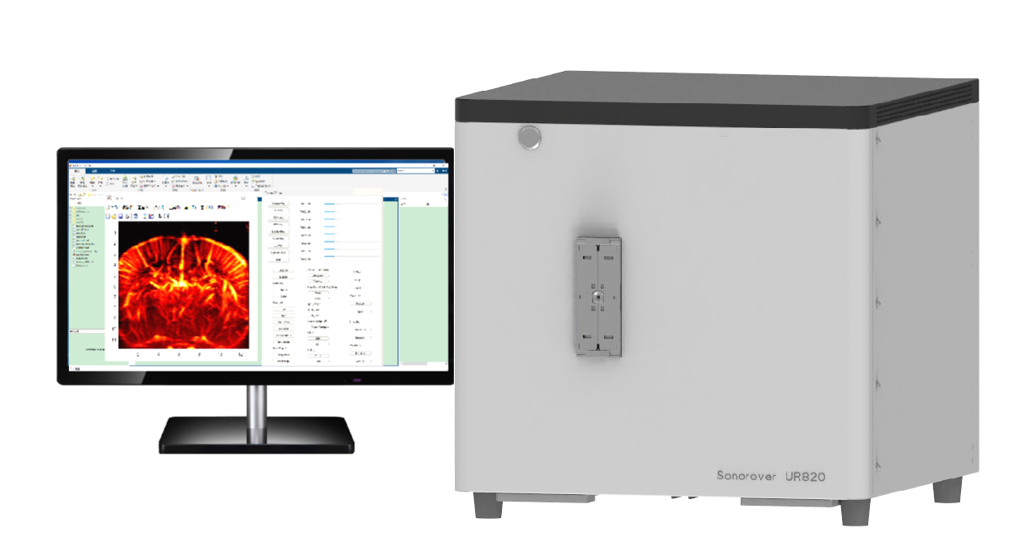
SonoRover fUS is a high-resolution brain function ultrasound imaging system designed specifically for experimental animals. Equipped with a high-performance processor and advanced microvascular blood flow imaging algorithms, it can image the whole brain function of experimental animals such as mice and rats with high temporal and spatial resolution. Equipped with a variety of high-frequency transducers, it can accurately match experimental animals of different depths and sizes, and features a unique integrated diagnostic and therapeutic probe that enables simultaneous neural regulation and imaging. This technology has enormous potential for application in neuroscience, such as research on brain function disorders, neural feedback regulation, drug screening for brain diseases, neuropsychiatric disease research, and brain-computer interfaces.
Verification of spatiotemporal matching between brain functional imaging and neuronal activity
Whole-brain deep brain imaging: Capable of simultaneously capturing detailed information about the entire brain and deep brain regions, expanding the imaging coverage;
High frame rate brain imaging: supports fast dynamic imaging, capturing rapid changes in brain functional activities, suitable for real-time monitoring;
High spatial resolution: With fine spatial resolution, it ensures that tiny brain structures are clearly presented to improve diagnostic accuracy;
High temporal resolution: With extremely high temporal resolution, it can accurately capture instantaneous fluctuations in brain functional activities and support dynamic analysis
Ultrasound diagnosis and treatment integrated module
Integrated diagnosis and treatment: Integrates ultrasound imaging and neuromodulation functions, supporting synchronous or independent working modes;
High-performance hardware: equipped with a 128-element probe and a 5-10MHz wide frequency range, balancing imaging resolution and depth control;
Modular expansion: flexibly adapt to multiple scenarios and provide more innovative applications for scientific research and clinical practice
Application Scenario
Neurological disease model research: used for functional evaluation of small animal neurological disease models to help explore the pathogenesis of diseases such as brain injury, stroke, epilepsy, and Parkinson's disease;
Brain Functional Network and Behavior Research: Analyze brain functional activity in small animals while they perform specific behavioral tasks, and explore the role of neural networks in cognitive, emotional, and motor behaviors;
Drug screening and efficacy evaluation: used to evaluate the effects of drugs or treatments on brain function and provide real-time monitoring of changes in brain function;
Gene editing and neural regulation research: combining gene editing technology to study the effects of specific genes on brain function in small animals;
Brain-computer interface technology research: Explore the application of brain-computer interface technology in small animal experiments, study the interaction between brain signals and external devices, and lay the foundation for the future clinical application of brain-computer interface
- Prev: Technical Analysis | Ugo Basile Startle Reflex Prepulse Inhibition (PPI) Test System: A Key Tool for Detecting Sensorimotor Gating Function
- Next: Technical Analysis | Yuyan Ultra-High-Resolution Small Animal Ultrasound Imaging: Accurately Assisting Research in Cardiovascular, Oncology, and Brain Function